
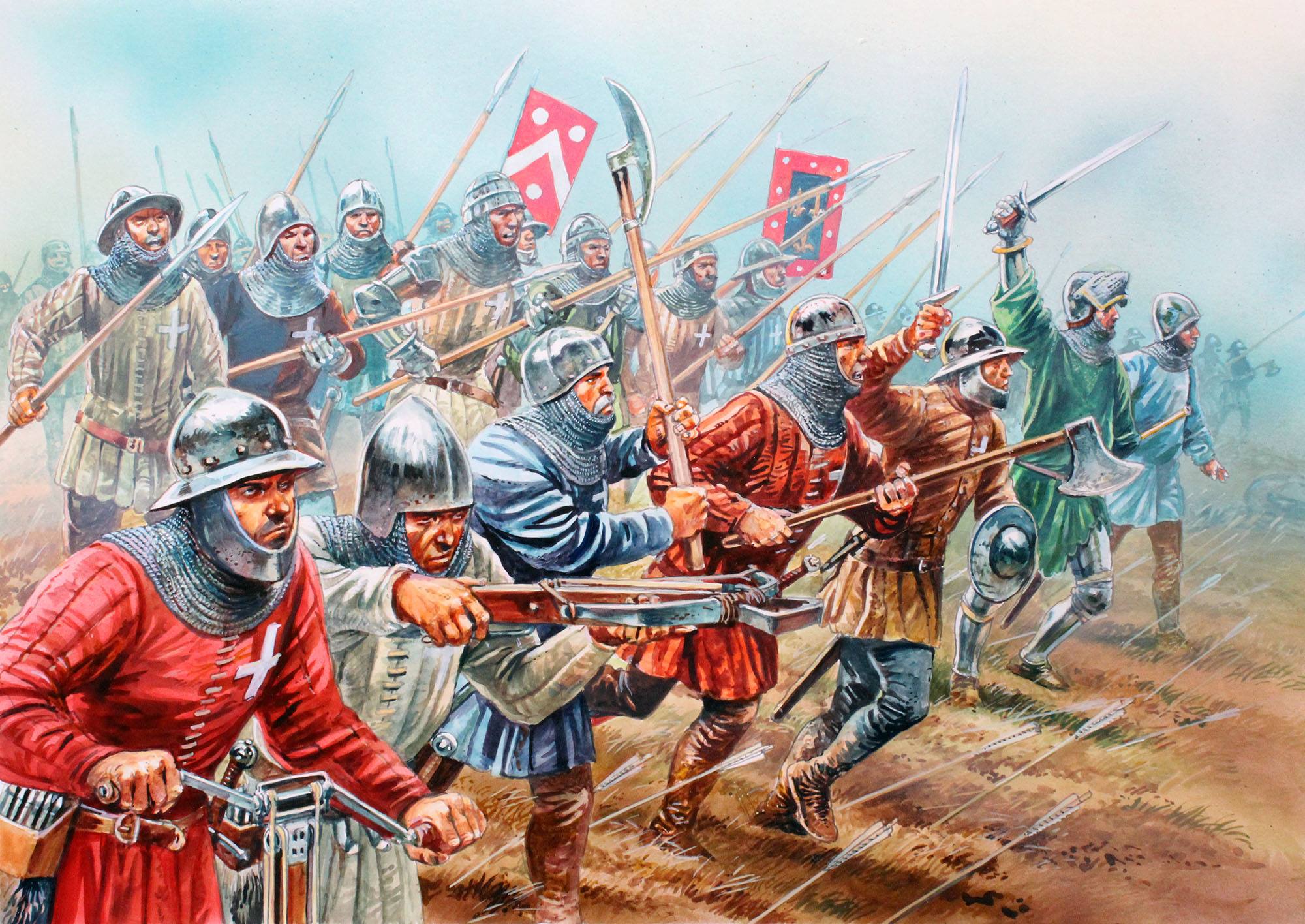
Infantry in the Middle Ages
The composition of the medieval army was ever-changing over the course of centuries.
Hollywood and Folklore portray stories of armies, consisting a hundred thousand soldiers that went to war in central Europe on a regular basis. When looking at the Early Middle Ages (ca. 500 - 1050) we find much smaller numbers documented. Larger battles had a size of 30,000 to 40,000 men and it often occurred that a battle was fought by a few hundred men on each side. The reason for that was quite simple. Even if a lord had more men than that it would have been difficult to sustain supplies and transportation at this early point in history.
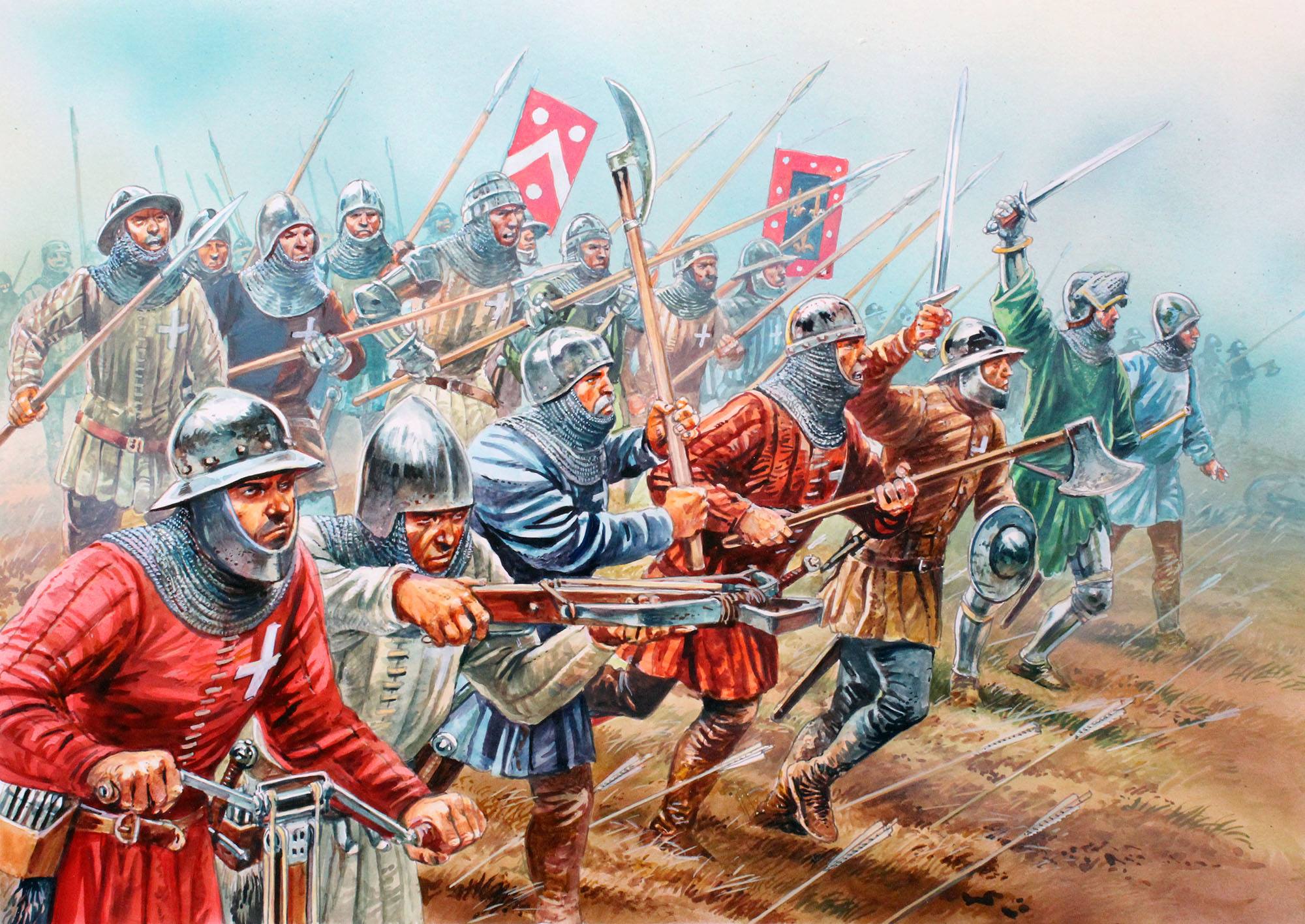
In the Early Middle Ages an army’s composition heavily relied on untrained men. If a city was under a siege, a large chunk of soldiers were recruited from the people of the kingdom performing duties such as craftsmen, cooking and so on. In case like these, men were armed with what they found at home. In the Early Middle ages, it still occurred relatively often that a household still had a weapon. In the High Middle Ages it was forbidden for a normal resident to have a weapon at home that could not be used as a tool for every day work.
From time to time, a lord distributed medieval weapons to the troops. These weapons were chosen by two factors:
a) Whether or not these were cheap to manufacture so that these could be provided in large numbers,
b) How simple it was to use so as even untrained men could use these effectively.
This gave birth to the medieval weapon for infantry: The polearm Specifically spears were in heavy use as these were fitting the purpose perfectly. On one hand was a spear that had just a small tip made of metal that made it relatively cheap to manufacture compared to other medieval weapons. On the other hand it was also very easy to use a spear without any training and still be effective on the battlefield.
Of course medieval armour was way too expensive for these untrained troops. From time to time they used a simple helmet such as a kettle hat or a skullcap as time passed by. Since, the High Middle Ages, Medieval troops also started with the use of a body armour like a Gambeson.
Knights had a different situation with regards to equipment. In the Early Middle Ages, the term "knight" was not related to a social title which is why everybody could be a knight who had fitting knight armour. It was in the 12th century when the term "knight" changed its meaning and became the role that we know about nowadays.
From this time on, the well equipped, armoured horsemen were no longer a knight if they were not promoted to have this title. These men became men-at-arms and created a new category of Infantry in the Middle Ages. Compared to the untrained troops from that time the men-at-arms were the first professional soldiers of that time and their numbers grew large over the course of the Middle Ages.
With the greater budget of a man-at-arm, he could not only afford a Gambeson but also a chainmail and additional chainmail parts . In case the soldier was a horseman he often choose a lance and on foot it was easy for these professional soldiers to fight with a sword an axe or a short pole axe

Towards the end of the Middle Ages, there was another change in the army composition in Europe. Infantry were recruited on a larger scale and the soldiers were equipped with spears and polearms to fight in formations which they were trained for before battle. During this time, the armour also changed once again. Breastplates that once were the symbol for knights, soon became available to the regular soldier during this time. Also, additional plated armor parts like gauntlets became more and more popular. The reason for that was the technical progress in metal working and the fact that this army composition implied almost only mercenaries.
These mercenaries had to buy their equipment on their own and it was not very surprising to witness how much they invested to protect their lives. The Lords of the armies of that time were freed from the costs to equip their armies, so they could use the budget to increase the size of their forces. The budget that was once needed for medieval weapons and medieval armour was now directed to expenses for supplies and transportation. Armies grew larger and larger and the way wars were fought changed once again.